
Egypt is one of those destinations that seems to be on everyone’s bucket list – and for good reason. When I was doing my research, however, I kept seeing mixed reviews on the tourist experience there. In light of this, I decided that for my first visit to Egypt, I would join a group trip with Intrepid Travel. The specific itinerary I chose is called “Egypt Adventure,” which is a seven-night trip for small groups (my group had 13 people and one guide). I visited Egypt in December of 2025, and I honestly can’t say enough good things about my experience. Read on for an inside look at what my trip was like!
Day 1: Arrival in Cairo


I landed in Cairo in the early afternoon, purchased my visa on arrival (it cost me $25) and used a rideshare app called Careem to get to my hotel. One thing to note using this app specifically in Egypt is that the license plate number will be listed in Arabic. This is not a huge issue as you can still look for your driver and make sure the numerals match, but it’s worth calling out here.


I dropped my luggage at the hotel and still had about two hours before my group was scheduled to meet. I wanted to visit Tahrir Square, which was the center of the 2011 Egyptian Revolution and is a huge symbol of protest and liberation. One thing you must know before traveling Egypt is that it is ILLEGAL to take photos of government buildings and officers. You are allowed to take pictures of monuments like Tahrir Square – I even confirmed with a nearby police officer just in case.


After I finished at Tahrir Square I stopped into a papyrus shop. You will see papyrus paintings everywhere in Egypt, and they can make a great souvenir. However, you want to make sure you are getting the real thing and that you are haggling on price. You are more likely to get real papyrus in a brick-and-mortar shop, and the prices should range anywhere from tens to low hundreds of US dollars. A large papyrus painting (about 2 feet) should not cost you more than $100 USD.


That evening, we had a team meeting at our hotel to go over the trip expectations and itinerary. We were advised not to drink the tap water (even using bottled water to brush our teeth), and we were also told to be cautious of things like fruit juices that would be made with tap water. After the meeting, we visited the Khan el-Khalili market for some shopping and had dinner at our hotel, Pharaoh’s Hotel in Cairo.
Day 2: Pyramids and GEM


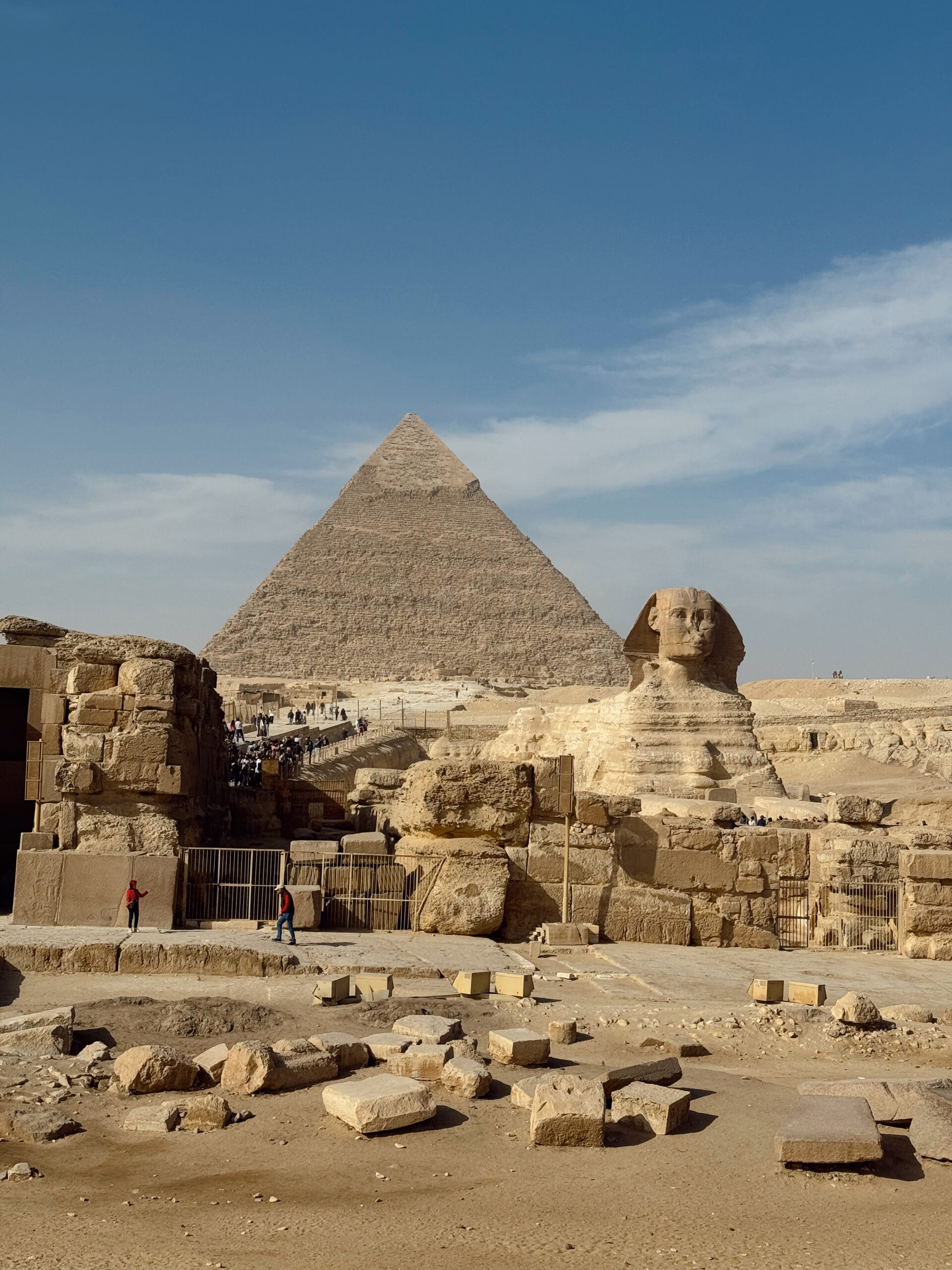
We had an early start this morning so we could beat the crowds to the landmark Egypt is most known for, the Pyramids of Giza. Our guide gave us a lesson about the pyramids before allowing us around an hour of free time to explore on our own.


About half of our group chose to pay $30 to visit the inside of one of the pyramids – afterwards they agreed that while it was cool to see, it was also very hot and cramped inside. I chose not to go inside and spent my time walking around the pyramids and of course, getting some photos!


Next we walked over to the Sphinx and had a lesson about this iconic landmark as well. It’s hard to put into words how amazing it was to see these things in person after learning about them so many years ago. We had some more free time to enjoy the Sphinx and wander around the pyramids complex.


As the site gets busier, there are lots of locals who will offer to take your photo, but don’t necessarily tell you that they expect payment afterwards. It’s best to just say no thank you and be kind, but adamant about it. There are camels specifically for photo ops, but they are tied up all day so I would heavily advise against paying for a photo with one.


We had lunch at a restaurant that serves koshari, which is the national dish of Egypt. It’s made with rice, lentils, pasta, and chickpeas and is tossed with tomato sauce and crispy fried onions. You mix the tomato sauce in yourself and can add chili sauce to taste – I thought the dish was pretty good overall and was very filling. It’s always worth trying the national dish while traveling if you can!


We spent the afternoon at the brand-new Grand Egyptian Museum, which opened on November 1st of 2025. This is the largest museum in the world for a single civilization, with over 100,000 artifacts. In the lobby you’ll find the 11 meter tall statue of Ramses II, and the main exhibits are spread across 12 permanent galleries.


One of the most popular galleries is the one that houses King Tut’s treasure, including his sarcophagi and thousands of pieces that were buried alongside him. His golden mask is held in a glass case and has a crowd around it at all times – I think this is the Egyptian version of the Mona Lisa at the Louvre! You could truly spend days in this museum, but I think it’s possible to get the gist in a few hours’ time.
Click here for a similar tour that includes the Pyramids, Sphinx, lunch and Grand Egyptian Museum


That evening we picked up our luggage from the hotel and went to board a sleeper train from Cairo to Aswan. This was my first experience on a sleeper train, so I was really excited to see what it was like. You are served dinner and breakfast onboard, but we also picked up snacks in advance. Unlike trains in Europe, smoking is allowed in the club car onboard and BOY is it pungent. You don’t really smell it from the other cars (thankfully), but I would plan not to use the club car at all. The train is in need of a touch-up, but it gets you from A to B which is what matters most!
Day 3: Philae Temple & Nubian Village


After a (not-so-great) night of sleep on the train, we woke up in Aswan! We checked in to our hotel, Obelisk hotel, which was right on the Nile. We had time to get coffee, change, and freshen up before heading to Philae Temple. The temple complex is located on an island, so you take a short boat ride to get there.


Philae Temple is impressive in part because the entire thing was taken apart and rebuilt where it is today. This is because the dams that were built on the Nile River would have eventually flooded the site. The work that was done to preserve the temple complex is incredible, and it’s amazing to see what could have been lost.


After our visit to the temple, we had a few hours at our hotel to swim, relax, and freshen up. That night, we had dinner at a Nubian village in a family’s home. They took us on a tour of their village, shared a home-cooked meal with us, and we ended the night with conversation and dancing. We tried to get to bed early this night since we had to leave before 5:00am the next day to visit Abu Simbel.
Click here for a similar Philae Temple tour
Click here for a similar Philae Temple tour plus High Dam, Unfinished Obelisk, and Nubian Village
Day 4: Abu Simbel


We had an early morning bus ride to Abu Simbel, which was an optional activity on this itinerary (12 of the 13 of us chose to go). Abu Simbel is located near the southern border of Egypt and is a 4-hour drive from Aswan. It’s possible to fly to Abu Simbel, but of course it’s more expensive. About halfway through our drive, we stopped at Sarab Coffee to use the restroom and get something to drink.


A few hours later we had arrived at Abu Simbel. Our guide gave us a primer and then set us loose with some free time to explore. Abu Simbel is comprised of two massive temples that were originally carved into a mountainside but had to be relocated like Philae Temple to avoid flooding. Rameses II had the temples built during his reign in 13th century BC, dedicating one to himself and one to his wife, Queen Nefertari.


After a four-hour bus ride back to Aswan, we had the rest of the day free to spend however we liked. Most of the group took a nap and freshened up before we had a group dinner at the hotel to celebrate one of our group members’ birthdays. We enjoyed some local wine and beer before calling it a night.
Click here for a similar Abu Simbel tour from Aswan
Day 5: Nile Felucca
This morning we had free time to sleep in, relax, or explore more of Aswan. We had to prepare a small bag with our essentials for the next 24 hours because today we would be boarding a traditional felucca boat and would need to place our large bags in the hull. The felucca was larger than I expected and has a padded area we could spread out on and relax in the shade (this was also where we would be sleeping later).


About 30 minutes into our sailing venture, I had to take nausea medicine – since we weren’t actually sailing anywhere in particular, the boat kept slowly spinning and was making me feel sick. I felt better after taking the medicine and eating lunch, after which we went to the top deck to lounge and relax in the sunshine. Thankfully we did pull over to an island for a half hour, which gave us a nice break.


The group spent time listening to music, reading, or chatting until dinnertime. After dinner, we broke into the alcohol we had ordered in advance (our guide organized this for us, so we were able to select the beer and wine we wanted to have on board). For the rest of the night, we played music on a speaker, drank, and hung out on the top deck. We finally called it in the early morning and spent the night sleeping under the stars!
Click here for a similar (but much shorter) felucca ride with meal
Day 6: Drive to Luxor & Karnak Temple


The next two days were both early risers. We had a simple breakfast on the boat around 6:00am before getting on a bus to Luxor. The bus ride takes about 4 hours, and I’m pretty sure everyone slept the entire way. We made a short stop at an animal hospital and rescue in Luxor that the Intrepid Foundation supports. They gave us a tour of the facility, and the best part was that we got to pet lots of animals! This poor donkey is recovering from a bullet wound. 🙁


We checked in to our hotel, Aracan Eatabe, and had a few hours to eat lunch, freshen up, and rest. I ordered room service and took a shower before meeting up with the rest of the group. That afternoon, our guide took us on a tour of Karnak Temple.


Karnak is a huge temple complex in Luxor that was part of the monumental city of Thebes. It is a UNESCO World Heritage site and is considered to be the second-most visited historical site in Egypt behind the pyramids. Our guide told us a lot of history about the temple before giving us free time to explore and get our pictures in.


We had a group dinner at Al Sahaby Lane Restaurant, which had incredible food and offered rooftop views of Luxor and the Nile. After dinner, we walked past the Luxor Temple on our way back to the hotel so some of us could prepare for another very early morning.
Click here for a similar Karnak Temple and Luxor Temple tour
Day 7: Hot Air Balloon, Valley of the Kings, & Hatshepsut Temple
This was the earliest morning wake-up of the trip, and it was entirely optional. Seven of us had to be downstairs ready to go at 4:30am, but it was completely worth it. For $120 each, we got to do an hour-long hot air balloon ride over Luxor and the Valley of the Kings. I had never done a hot air ballon ride like this before, and I am happy to say it was one of the most incredible things I’ve ever done.


The hot air balloon ride took us over several sites: Karnak Temple, Hatshepsut Temple, Valley of the Kings, and the city of Luxor itself. It was so much fun to see all of the other balloons in the air and see the landscape of Egypt from above.
Click here for a similar sunrise hot air balloon ride in Luxor


After the hot air balloon ride, our entire group went to the Valley of the Kings. This is an area where rock-cut tombs were excavated to bury pharaohs and powerful nobles in ancient Egypt. There are lots of tombs in the valley, but at any given time some of them are closed for restoration or exploration.


The main entry ticket gives you access to some, but not all, of the tombs that are open. We got to choose which, if any, of the additional tombs to pay for. I paid for all three optional tombs: Ramses V & VI, Seti I, and Tutankhamun (King Tut). If you are already at the Valley of the Kings, I would say it’s worth it to pay for the additional tombs. They are incredibly well preserved, although I’ll note that it does get quite hot since you are underground.


Our group was interested in visiting the mortuary temple of Hatshepsut, so our guide added it in to our itinerary. This three-tiered temple is unique in the way it is set at the base of the cliffs behind it. A man offered to tie my scarf into a turban (and actually meant it when he said he didn’t want to be paid)!
Click here for a similar Valley of the Kings and Hatshepsut Temple tour


The last stop of the day was an alabaster workshop. There are many of these in Luxor, but at this particular shop they showed us how things are made and told us about the different types of alabaster. Most of us ended up picking up a souvenir or two from this shop before heading back to the hotel to get our luggage. We had one final sleeper train back to Cairo, so we picked up some local beer and wine for the journey before climbing aboard.
Day 8: Wake up in Cairo and say goodbye 🙁

Since it was the last night of the trip, most of us did not actually sleep on the sleeper train. Instead, we spent our final hours together crammed in a cabin so we could hang out. Even though we were exhausted, this was one of the highlights of the trip. After we arrived back in Cairo, we were devastated to go our separate ways and have the trip come to an end.
In the end, I was SO glad I booked this trip with Intrepid. Based on my experience, I would feel totally comfortable traveling solo in Egypt, but I understand why some people would not feel that way. Regardless, I think anyone with a sense of adventure would really enjoy the Intrepid trip. Having a guide to organize everything and teach us about the things we were seeing made it that much more impactful.
If you are interested in visiting Egypt, here are the most important things I would tell you:
- Don’t drink the tap water – they are serious about that. It’s not worth finding out why.
- Always carry cash – some restaurants and historical sites will take credit cards, but most vendors and shop owners will not. Ask your hotel which ATM to use, and when in doubt, try to use one inside a bank.
- Get comfortable saying no – vendors here are just trying to make a living, and they can be quite persistent when trying to sell you things. Saying no in Arabic (“Laa, Shukran”) goes a long way, but you may have to say no many times in order to get your point across. This doesn’t bother me, but it may bother other travelers who aren’t prepared for it.
- Dress modestly – although you can technically wear whatever you want, the locals will be dressed modestly. You’ll likely feel more comfortable if you are dressed modestly as well. I wore light pants and a light long-sleeved top most days, but I wore a t-shirt and shorts on the felucca.
- Learn a few words in Arabic – I studied Arabic in college, so I was excited to test my vocabulary in Egypt. Every time I said something as simple as hello (“Marhaba”) in the language, the locals ate it up! Some even gave me discounts just because I “spoke Arabic.” You don’t need more than a few words, but the locals will appreciate the effort.
If you made it this far and are interested in booking a trip to Egypt for yourself, I would love to be your travel advisor! I am able to book Intrepid trips, Nile river cruises, and everything else – hotels, tours, car rentals, etc. Shoot me an email at courtney.brooks@fora.travel to get started.